Charlotte de Witte Built a Fortress When the Clubs Wanted a Bridge
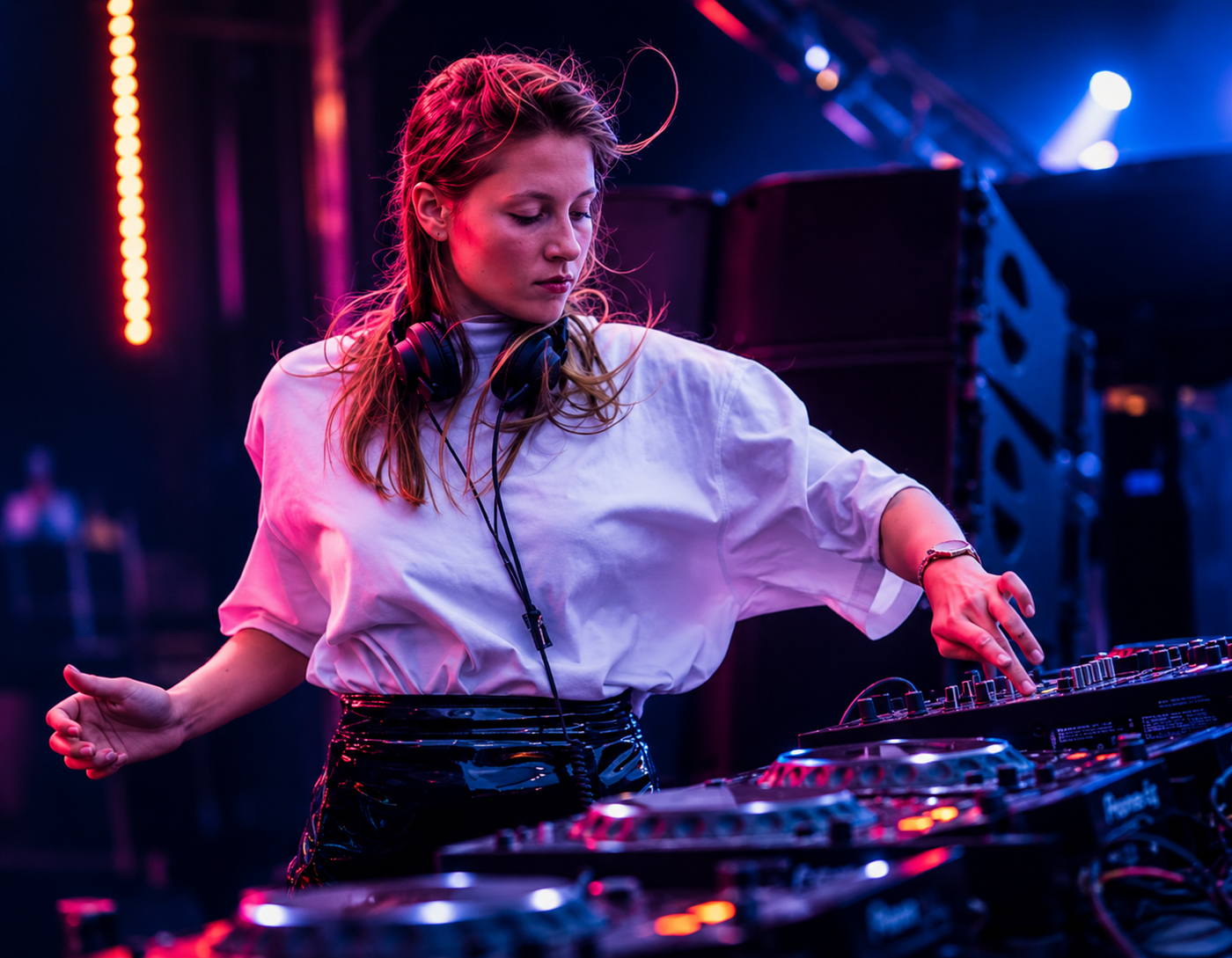
Charlotte de Witte's self-titled debut album lands in November 2025 with acid lines so corroded they sound like they were run through a TB-303 that's been left in a basement since 1987. "The Realm" opens with that signature chew, the filter sweep so slow you can hear each harmonic bite into the next, 135 BPM locked like a metronome with no mercy. It's the sound she's been refining since her 2018 Healer EP, when she pivoted from electro into this raw minimal strain, all low-end weight and negative space. Eleven tracks of it. No features except XSALT on organ duties and Lisa Gerrard doing her Dead Can Dance thing on the closer. She calls it "a selfish album." She's not wrong. The question is whether selfish is the same as necessary.
Charlotte de Witte's production vocabulary hasn't changed in five years. Metallic basslines, sine wave leads, acid breakdowns that sound like they were programmed on hardware because they probably were. KNTXT, the label she founded in 2019, has become a fortress for this exact sound. Vision, Return to Nowhere, Formula, Asura, Universal Consciousness, Apollo. Every release since 2020 has been a variation on the same architecture: Belgian techno's stripped-down brutalism, inherited from Amelie Lens and the Hasselt scene but pushed harder into the red. When she collaborates, it's with Amelie Lens ("One Mind," 2025) or Marion Di Napoli (Sanctum EP, 2024), artists who share her refusal to soften the edges. Even the Comma Dee feature on "The Heads That Know" just adds drum and bass's rhythmic stutter to the same crushing low end. There's a purity to it. There's also a ceiling.
She's playing to 20,000 people in Genoa's Piazza Matteotti in April 2026, Outline GTO C-12 stacks blasting 135 BPM into a public square like it's a bunker rave that escaped containment. Two sold-out anniversary shows at Flanders Expo in February with Richie Hawtin and Armin van Buuren on the bill. Six sold-out New York shows in four days. The rooms are full. The question isn't whether Charlotte de Witte has an audience. The question is whether her sound represents Belgian techno's future or whether she's the last generation defending a template the rest of the scene is already dismantling.
Because here's what's missing: evolution. Charlotte de Witte in 2026 sounds like Charlotte de Witte in 2021, which sounds like Charlotte de Witte in 2018 if you're being honest. The same tempo range, the same timbral palette, the same arrangement structure. Intro, breakdown, acid line, drop, repeat. It works on a 20,000-person PA system. It works in Fabric's Room 2. But listen to what's happening in Berlin right now, the way Anastasia Kristensen is pulling EBM and coldwave into techno's frame, or how Parfait is using ambient's texture language to crack the 4/4 grid open without abandoning it. Charlotte de Witte isn't interested in any of that. She's interested in being the best version of a sound that already exists. That's admirable. It's also conservative.
The Flanders Expo shows are instructive. Richie Hawtin, the man who spent the 90s tearing minimal techno down to its skeletal frame, sharing a bill with Charlotte de Witte, who built her career on that same frame but never questioned whether it needed to be rebuilt. There's reverence in that booking. There's also a warning. Hawtin's legacy is innovation. Charlotte de Witte's legacy, if she's not careful, will be competence. Brutal, uncompromising, massive-sounding competence. But competence nonetheless.
She has the platform, the label infrastructure, the audience scale to do something genuinely disruptive. KNTXT could be the place where Belgian techno evolves past its own mythology. Instead, it's the place where that mythology gets louder. That's a choice. And right now, with 20,000 people in an Italian square and two nights at Flanders Expo, it's a choice that's working. The floor is full. The question is how long before the floor wants something it hasn't heard before.
More Electro
- Rochelle Jordan's Disc 4 EP: Remixes by Louie Vega, Holly and More
- Nitsa Club and Primavera Bits Launch Nitsa PM With Folamour
- Hiroshi Yoshimura's Quiet Forest Returns for Its 30th Anniversary
- Lost Frequencies, Gryffin Share "Wait All Night" With Michael Marcagi
- Becky Hill's Album REBECCA Is Out Now
- Anyma Sets ÆDEN Millennium at Giza, March 19 and 26, With Jarre